
Sheet 03 of 12
Edge Flanges: Height, Angle and Bend Position
In 5 minutes you'll add an edge flange, set its height and angle, and see how Inside, Outside and Middle move the bend and change the flat length.
- Part
- Edge Flanges
- Rule
- Steel 2mm
- Sheet
- t 2 · R 2 · K 0.4
- Time
- 5 min
- Status
- Open
OP 10Watch
Video in productionBuild along with the steps in OP 30 meanwhile.
Chapters
- 00:00What an edge flange is
- 00:30The base plate
- 01:00Flange on an edge: height and angle
- 01:50Bend Position: Inside, Outside, Middle
- 03:00A flange at 120°
- 03:40Common mistake: a flange too short
- 04:20Your exercise
OP 20Turn the part
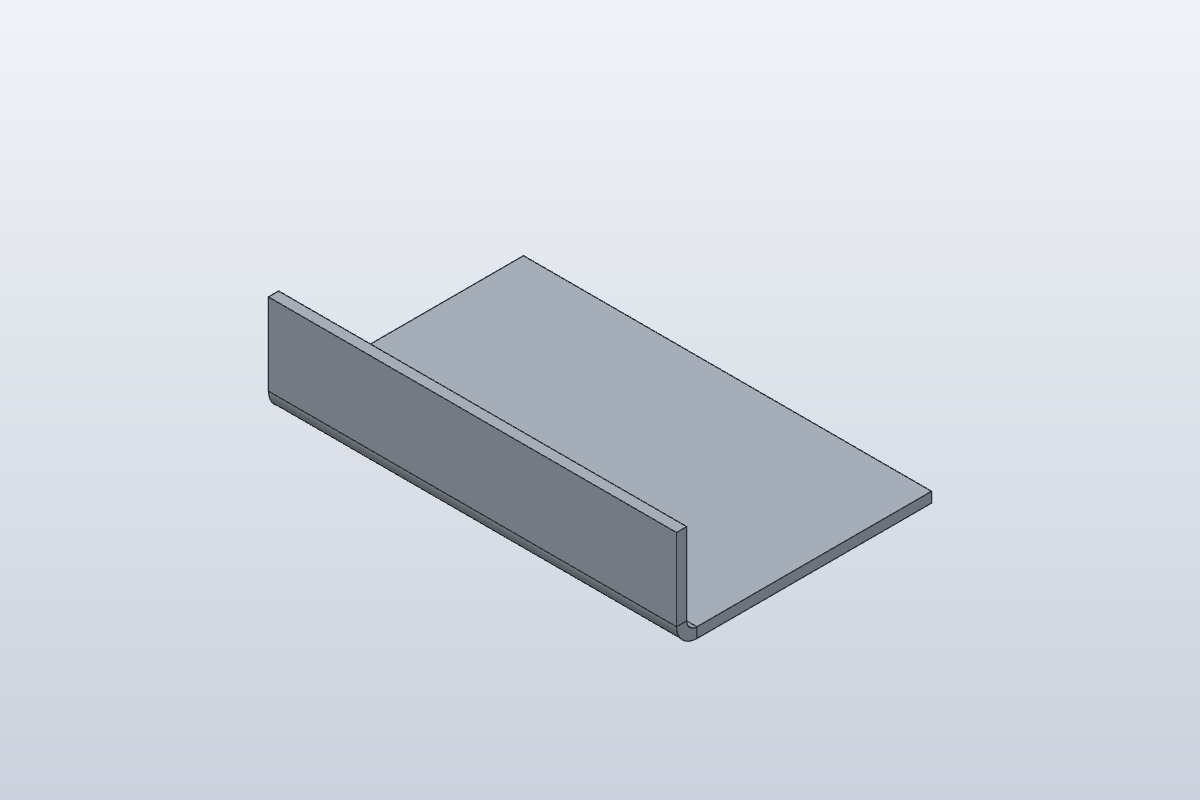
Drag to turn, scroll or pinch to zoom. Flat shows the blank before it is bent: the same sheet, the same frame.
OP 30Build it in SolidCraft
Your task
Make this bent plate in SolidCraft 0.21:
- In a new design, make the rule Steel 2mm (thickness 2 mm, bend radius 2 mm, K Factor 0.4) and keep Active rule ticked.
- Sketch an 80 × 50 mm rectangle on the XY plane, corner at the origin. Finish the sketch.
- Flange on the rectangle: the flat plate.
- Flange again: click the top edge of the long front side. Height 20 mm, Angle 90 deg, Bend Position Inside. OK.
- Click Flat Pattern (Sheet Metal tab › Flat) and write down the second number of Flat size.
- Edit the flange (double-click it in the timeline), set Bend Position to Outside, OK. Read the flat size again.
- Try Middle too, and see that its flat length lands halfway between the other two.
- Set Bend Position back to Inside and Angle to 120 deg. Read the flat size and the angle on the Bend 1 line.
What to write down
- The flat length across the bend with Bend Position Inside.
- The same with Outside.
- The flat length with Inside at 120°, and the angle shown for Bend 1.
The first number of the flat size is 80 mm every time: the bend runs along it. Type the other values below and press Check.
OP 40Inspect
Enter what SolidCraft shows you. Each value is checked against SolidCraft's own result, within the tolerance shown. Nothing you type leaves this page.
Show the drawing and bend table
exercise · Steel 2mm · t 2 · R 2 · K 0.4Flat blank 80.000 × 66.398 mm · 1 bend
| Bend | Angle | Dir. | R mm | Length mm | Allowance mm |
|---|---|---|---|---|---|
| 1 | 90° | up | 2 | 80 | 4.398 |
exercise-120 · Steel 2mm · t 2 · R 2 · K 0.4Flat blank 80.000 × 62.008 mm · 1 bend
| Bend | Angle | Dir. | R mm | Length mm | Allowance mm |
|---|---|---|---|---|---|
| 1 | 120° | up | 2 | 80 | 5.864 |
exercise-middle · Steel 2mm · t 2 · R 2 · K 0.4Flat blank 80.000 × 68.398 mm · 1 bend
| Bend | Angle | Dir. | R mm | Length mm | Allowance mm |
|---|---|---|---|---|---|
| 1 | 90° | up | 2 | 80 | 4.398 |
exercise-outside · Steel 2mm · t 2 · R 2 · K 0.4Flat blank 80.000 × 70.398 mm · 1 bend
| Bend | Angle | Dir. | R mm | Length mm | Allowance mm |
|---|---|---|---|---|---|
| 1 | 90° | up | 2 | 80 | 4.398 |
OP 50Quiz
Q1With Bend Position Inside, where does the flange's outer face end up?
Inside keeps the part within the sketch outline: the outer face of the flange sits on the edge you picked.
Q2You change Bend Position from Inside to Outside. What happens to the flat length?
Outside adds the bend beyond the plate's edge and keeps the whole plate, so there is more material in the flat.
Q3What does an angle of 120° do to an edge flange?
The angle is how far the flange is bent from flat: 90° stands it upright, 120° goes further and leans it back over the plate.
Every value is within tolerance. This sheet is done.
Sheet 04: Corners and Reliefs